United States Penitentiary, Leavenworth
Killers of the Flower MoonThe United States Penitentiary, Leavenworth was both a federal fortress and the unlikely setting for the next chapter of Tom White’s career. After the convictions of William K. Hale and John Ramsey, White was asked to leave the Bureau of Investigation and take charge of the Kansas prison. Its walls would soon contain the men he had helped bring to justice—and place him in a new kind of authority over them.
Appointment and Arrival
The assistant attorney general overseeing the federal prison system considered White an ideal choice to lead Leavenworth, then regarded as one of the country’s most dreaded penitentiaries. Allegations of corruption made the appointment especially consequential. J. Edgar Hoover did not want to lose White from the bureau, but acknowledged that opposing his promotion would be unfair. White wrestled with the decision before accepting: the position brought higher pay, allowed him to stop uprooting his wife and young sons, and echoed his father’s work as a prison warden, though on a far larger scale.
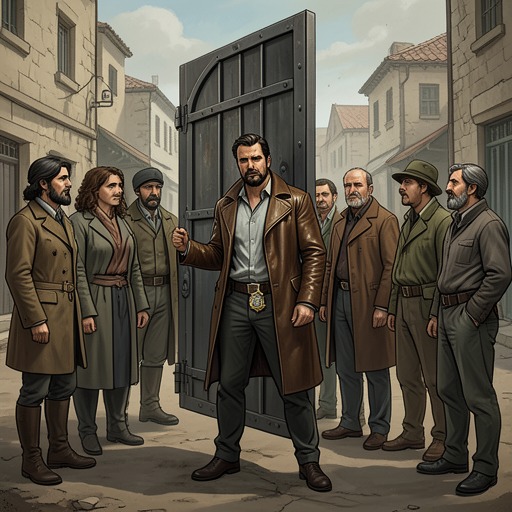
On November 17, 1926, while White was still settling into the job, U.S. marshals convoyed two new inmates up the prison’s horseshoe driveway. Leavenworth covered 366,000 square feet and rose from surrounding cornfields like what one prisoner called a “giant mausoleum adrift in a great sea of nothingness.” The shackled men approaching its entrance were pale from lack of sunlight. White recognized them as Hale and Ramsey. Hale greeted him by name; White returned the greeting, shook hands with both men, and watched as they were led away to their cells. The encounter joined the investigation’s courtroom outcome to its institutional aftermath: the former pursuer now ran the prison receiving the men he had pursued.
The Hot House and Its Inmates
T. B. White and his family lived on the prison grounds, where the scale of the institution became part of domestic life. His wife initially could not sleep, asking, “How do you raise two young boys in this kind of environment?” The prison had been designed for 1,200 inmates but held three times that number, and its crowded tiers made the warden’s new responsibility more than an administrative one. In summer, temperatures inside climbed as high as 115 degrees; prisoners came to call the place the Hot House.
As T. B. White walked the cell-block tiers, the prison seemed to gather figures from his earlier life behind bars. He encountered members of the old Al Spencer Gang and a former head of the Veterans Bureau who had committed bribery during the Harding administration. He also passed the two deserters who had killed his older brother, Dudley White. T. B. White never mentioned their connection, because he did not want to cause them distress. The penitentiary thus held not only men from his investigations but a private family loss he chose not to disclose.
Overcrowding and heat could turn routine strain into immediate danger. In August 1929, the prison kitchen’s milk soured in the heat, and a riot broke out in the mess hall. Red Rudensky, an infamous safecracker, remembered “ugly, dangerous, killing hate” in the room. T. B. White rushed in to quell the unrest, coming within a few feet of Rudensky while cleavers and broken, jagged bottles were inches away. Rudensky later recalled that the warden had shown courage by entering the violence rather than directing it from a distance.
Discipline and Rehabilitation
White’s authority at the United States Penitentiary, Leavenworth combined strict discipline with a refusal to tolerate abuse. A custodian who later worked under him recalled that “The Warden was strict with the inmates but would never stand for any mistreatment or heckling of them.” His approach did not erase the prison’s coercive structure; it set limits on how those in charge could exercise power within it.
He also believed prisoners needed purposeful work and that change remained possible. White sent Red Rudensky a note acknowledging how difficult it was to break from a long-established course, then urging him that if the resolve was there, “now is the time to show it.” Rudensky later said White’s support gave him “a ray of hope.” The exchange made rehabilitation personal and concrete: not a promise that every prisoner would change, but an appeal to one man to try.
White’s willingness to make room for a prisoner’s sustained work was clearest in his treatment of Robert Stroud, a convicted murderer who was allowed to keep an aviary in his cell. Stroud cared for some three hundred canaries and became known as the Birdman. His mother wrote to White in gratitude that someone who understood “human nature and its many weaknesses” held authority over her son. The aviary offered a striking counterpoint to the crowded, punishing institution around it: within the prison’s bars, care for living creatures could become both a daily occupation and a measure of the warden’s faith in rehabilitation.
Punishment, Routine, and the Men Who Remained
The prison’s work of confinement could culminate in a task its warden opposed. Carl Panzram, a repeat killer who had confessed to twenty-one murders and declared that he had no conscience, beat a prison staff member to death in 1929. Sentenced to be hanged inside the penitentiary, he was led to the newly built gallows at sunrise on September 5, 1930. T. B. White made sure his two boys were absent as Panzram, impatient with the preparations, urged his executioners to hurry. At 6:03 a.m. the trap opened. White had opposed capital punishment, but, as his father had once done in Texas, he oversaw an execution; it was the first time he had helped end a human life.
For William K. Hale, imprisonment meant a return to manual work. Initially assigned to the tuberculosis ward, he later worked on the prison farm, tending pigs and other animals much as he had on the frontier. A prison report praised his skill with livestock and his ability to treat abscesses and castrate animals. The work record offered a starkly ordinary image of a man convicted of murder: inside Leavenworth, the former rancher’s practical competence was put to use under institutional supervision.
T. B. White insisted that Hale receive the same treatment as other prisoners. When a reporter sought gossip about him in November 1926, White declined to provide it; he also made a point of ensuring that Hale’s wife and daughter were not slighted by prison officials. Although regulations allowed one visit a month, he welcomed Hale’s wife when she requested permission to visit sooner. Such fairness did not imply forgiveness or elicit an admission. Hale never acknowledged ordering the Roan murder for which he was convicted, or the other killings the evidence attributed to him. His trial statement about an attempt to swindle a headright—“It was a business proposition with me”—left the prison with a chillingly compact account of the logic he would not renounce.
Leavenworth did not settle Hale’s conviction at once. An appeals court overturned his verdict in 1928, and a man who had assisted the defense later confessed that Hale had arranged to have the case fixed. Hale was tried again and convicted, as was Ramsey. The prison thus became more than the endpoint of White’s investigation: it held the convicted men through a reversal and retrial, while White’s insistence on orderly, evenhanded custody stood in contrast to the criminal power they had exercised outside its walls.